


The Hidden Costs of Manual Dispatch: What Brokers Don’t Calculate But Always Pay.
Manual dispatch leads to hidden financial losses from delays, errors, missed updates and slow billing. Brokers don’t see these expenses up front, but they consistently reduce profit margins far more than the price of a modern Transport Management System (TMS).
Across the US and Canada, many brokers cling to manual dispatching because it feels simple and familiar. Spreadsheets, emails and back-and-forth communication seem like the “free” way to run operations. But nothing is more expensive than inefficiency and manual dispatch quietly builds layers of hidden costs that eat into profits month after month.
The irony? The costliest problems are the ones brokers don’t calculate because they never appear as a line item. Yet they show up everywhere else: missed loads, frustrated shippers, delayed updates, lost documents and long nights fixing preventable mistakes.
This is the financial truth of manual dispatch and why a modern Transport Management System is no longer optional but essential.
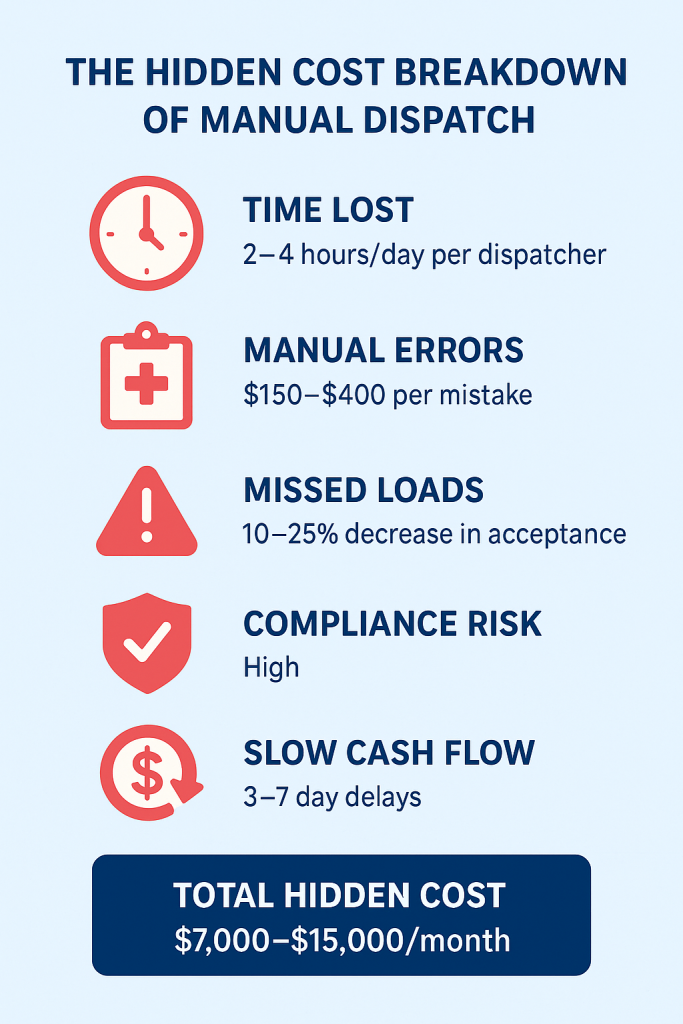
The time drain no one tracks, but every broker pays for
In a manual setup, dispatchers spend more time managing communication than managing loads. Hours disappear into phone calls, WhatsApp messages, repeated instructions, chasing drivers for location updates or searching for information buried inside long email threads.
It’s not the effort that hurts; it’s the opportunity cost. When dispatchers are stuck correcting errors or relaying the same instructions multiple times, they simply can’t handle more volume. A team that could efficiently manage 120 loads a week ends up maxing out at 70-80 not due to lack of capacity, but because manual workflows slow everything down.
A TMS software removes these bottlenecks by automating updates, consolidating communication and centralizing information. Dispatchers spend less time “finding” and more time executing.
Human errors that look small… until they become costly
A mistyped address, a missed accessorial charge, a wrong ETA or a forgotten detention update rarely feels like a major error in the moment. But each mistake compounds into bigger issues- failed appointments, extra fees, poor service impressions or even lost shipper trust.
Manual dispatching invites these mistakes because the process relies on memory, multitasking and inconsistent systems. Every dispatcher develops their own method and eventually, loads fall through the cracks. One missed update can cost a broker the entire load or worse, the entire customer.
Modern TMS software for brokers creates structure and safeguards: mandatory fields, auto-synced load details, unified notes, standardized workflows, and instant access to historical data. Errors decrease because the system does the remembering.
The price of not knowing where your drivers are
Real-time visibility is no longer an add-on, it’s a requirement. Shippers expect accurate ETAs, proactive alerts, and live tracking access. Yet brokers who rely on manual dispatch must depend on phone calls, inconsistent driver responses, or delayed updates.
The real cost is not the inconvenience. It’s the lost credibility. When brokers provide delayed or inaccurate updates, shippers view it as a reliability issue. Missed detention opportunities, appointment failures, and SLA breaches follow.
A Transport Management System fills this gap with built-in GPS tracking, automated status updates, map-based visibility, delay alerts, and digital proof of delivery. This creates consistency and trust, two things that manual dispatch cannot deliver at scale.
Compliance & documentation: The hidden risk lurking behind every load
In a manual environment, documents live everywhere in email attachments, WhatsApp downloads, computer folders, PDF version, notes and printed copies. Important details become scattered and when a shipper, auditor or carrier needs something urgently, the search becomes a nightmare.
What most brokers don’t realize is that documentation chaos is one of the biggest hidden risks. Missing insurance certificates, incomplete carrier packets, lost PODs or unclear communication records expose brokers to compliance issues, disputes and financial penalties.
A modern Transport Management System eliminates this uncertainty with centralized storage, searchable records, auto-tagged documents and real-time updates. Everything is stored, synced and retrievable instantly.
Communication delays that quietly erode customer relationships
Manual communication forces dispatchers to juggle multiple channels- phone calls, emails, texts, spreadsheets and verbal updates. This fragmentation often leads to miscommunication, duplicated effort or unclear instructions. Drivers may miss load details. Shippers may feel uninformed. Dispatchers get overwhelmed.
Over time, these “small” communication delays create an impression of disorganization, even when the team is working hard. A single missed update during a crucial delay can overshadow weeks of smooth performance.
A TMS system eliminates scattered information by bringing all load communication driver updates, location pings, customer notifications, internal notes into a single, cohesive platform. Less noise, more clarity.
Slow billing that delays cash flow (the cost nobody talks about)
When PODs arrive late or paperwork is incomplete, billing gets pushed back. For many brokers, manual processes delay invoicing by several days, sometimes weeks. This slows cash flow and increases dependency on factoring, which reduces margins even further.
A modern trucking management software changes this by allowing drivers to upload PODs instantly, automating invoice creation, and syncing documents directly to accounting. Cash flow accelerates, and brokers gain more financial control.
Manual dispatch has a growth ceiling and most brokers hit it sooner than they expect
A broker can only scale as fast as their system allows. Manual dispatch is exhausting, unpredictable, and error-prone, meaning the more volume you add, the more chaotic the operation becomes. Teams burn out. Customers get inconsistent experiences. Efficiency drops with every additional load.
Brokers in the US and Canada are increasingly realizing that scaling without a TMS is impossible. A Transport Management System isn’t about replacing people, it’s about amplifying what people can do.
It removes the ceilings that manual dispatch imposes. And in freight, the brokers who scale the fastest usually win.
Why more North American brokers are choosing Navislane
Navislane is built for modern operations, specifically for brokers and carriers who want to eliminate manual inefficiencies. Its real-time tracking, automated workflows, digital documentation and integrated communication help teams work faster while reducing errors and costs.
Unlike outdated legacy systems, Navislane is fast, intuitive and built for real-world US and Canadian lanes. It gives teams visibility, speed and confidence without the complexity that slows most TMS platforms down.
Conclusion: Manual dispatch isn’t tradition, it’s a financial leak
What brokers think is “simple” or “free” is actually the most expensive part of their business. Manual dispatch quietly drains money through mistakes, delays, outdated communication, and slow billing. The longer brokers rely on it, the more they pay often without realizing it.
A modern Transport Management System is not just a tool; it’s the difference between running operations and scaling them. For brokers in the US and Canada, the shift toward automation isn’t just happening, it’s necessary for survival.
FAQs
Does manual dispatch actually impact profitability?
Yes. It introduces delays, communication gaps, and errors that directly increase overhead and reduce margins.
Why do brokers switch to a TMS?
To improve speed, visibility, customer service, and billing efficiency while reducing manual work.
Is TMS worth it for small brokers?
Absolutely. A modern TMS creates structure and reliability at any size and supports rapid scaling.
Does a TMS help with compliance?
Yes. It centralizes documents, timestamps communication, and maintains organized records.

Related posts

Visibility Vs Control: What Brokers And Carriers Actually Need From Fleet Data
Key Takeaways Visibility vs Control: Why Fleet Data Still Leaves Leaders Unsure
Leave a Reply